
Merzouga, Hassi Labied, Khamlia and Rissani: a practical planning guide
Facts checked against public sources in October 2026. Prices, timetables and road conditions change, so confirm details before you book.
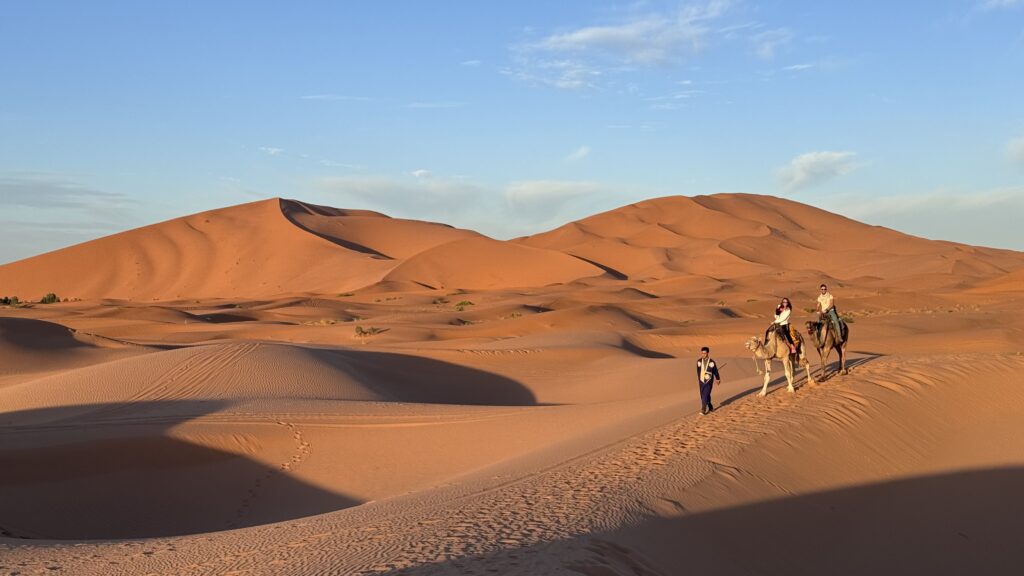
Erg Chebbi is Morocco’s most visited Sahara dune field: a long ridge of orange-gold sand rising from flat, stony desert near the Algerian border. The small town of Merzouga sits at its edge, which makes this the easiest place in Morocco to sleep among big dunes.
This guide is built for planning. It covers what to see, how to choose a camp, what to ask before you book, how camel rides can be handled with care, and how to cope with the long drive from Marrakech or Fes.
Prices, timetables and road conditions change often, so treat the details here as a starting point and confirm them before you pay for anything.
A quick note on names
Erg Chebbi (sometimes spelled Erg Chebi) is the dune field. Merzouga is the nearby town most travellers use as a base. Erg Chigaga (also spelled Chegaga) is a different dune field far to the south-west, near M’Hamid. They are not interchangeable, and the difference matters when you plan your route.
Erg Chebbi at a glance
| Where | South-eastern Morocco, near the Algerian border. Merzouga is the gateway town. |
| Size | Sources differ, but roughly 20–30 km long and several kilometres wide. The biggest dunes are commonly quoted at around 150 m. |
| Nearest airport | Errachidia Moulay Ali Cherif (ERH), roughly two hours by road from Merzouga. |
| Best seasons | March to May and October to November. Winter nights are cold; summer days are very hot. |
| Typical stay | Two nights near Merzouga, plus travel time. One night is possible but means very long driving days. |
| Money and language | Moroccan dirham (MAD). Arabic, Tamazight (Berber) and French are widely spoken; English is common in tourism. |
| Time zone | Morocco uses UTC+1 for most of the year and is expected to switch to UTC+0 during Ramadan. |
Erg Chebbi vs Erg Chigaga: which dunes are right for you?
Morocco has two main dune fields where travellers sleep out. They are often mixed up, so here is the short version: Erg Chebbi is easier to reach, taller and busier. Erg Chigaga is remote, more spread out and quieter.
| Erg Chebbi | Erg Chigaga | |
| Gateway | Merzouga (with Rissani and Erfoud nearby) | M’Hamid (Zagora is further north) |
| Access | Paved road to Merzouga. Many camps are a short transfer or walk from town. | Off-road tracks. A 4×4 is needed. |
| Camps | Many, from simple tents to high-end camps | Fewer, more remote |
| Atmosphere | Busier, with more services. Many camps offer evening drumming. | Quieter and wilder, with a stronger sense of isolation |
| Dunes | Tall, dramatic and orange-red | Broad and spread out, often described as yellower |
| Stargazing | Good, though neighbouring camps add some light | Often described as better because it is more remote |
| From Marrakech | Roughly 9–12 hours by road | Zagora alone is about 6–7 hours; M’Hamid and the off-road leg add more |
| Best for | First-time visitors, shorter trips and a choice of comfort levels | Travellers with extra days who want solitude |
Choose Erg Chebbi if this is your first Sahara trip, you have limited time, or you want a choice of camps at every comfort level.
Choose Erg Chigaga if you have extra days, are happy with rough tracks, and care more about solitude and dark skies than convenience.
Even at Erg Chebbi, atmosphere depends on the camp. Some sit deeper in the dunes, away from the busiest stretches, and feel more private than camps near the edge of Merzouga.
What to see around Erg Chebbi
The Erg Chebbi dunes
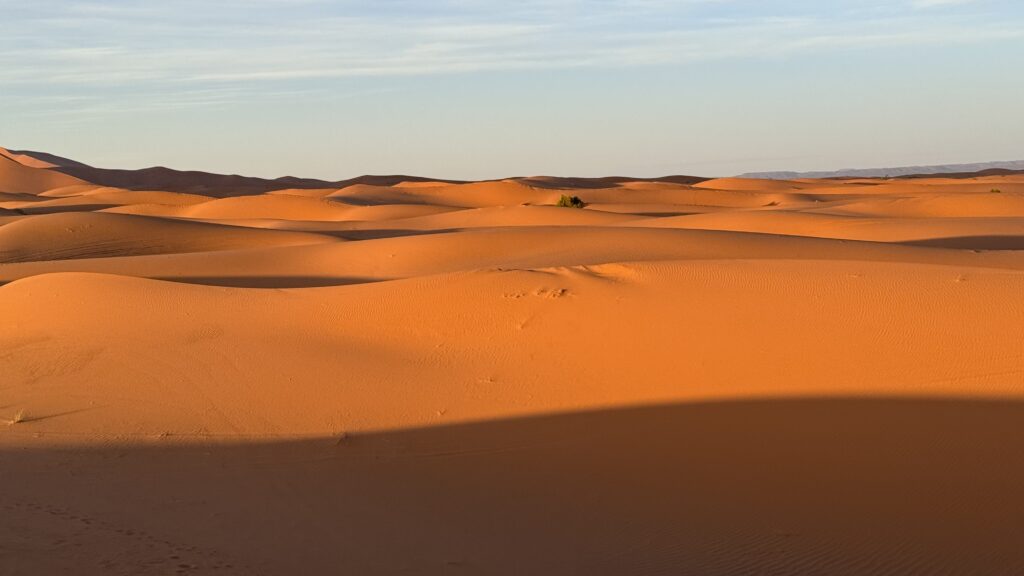
What stands out is the contrast: black, stony plain on one side, soft orange sand on the other. The dunes shift colour through the day, pale gold at midday and deep orange or red near sunrise and sunset.
They also move with the wind, so footprints vanish quickly and crest lines change shape. Walking on soft sand is slow and tiring. A short climb can take much longer than it looks, so do not plan a tight schedule around it.
Merzouga
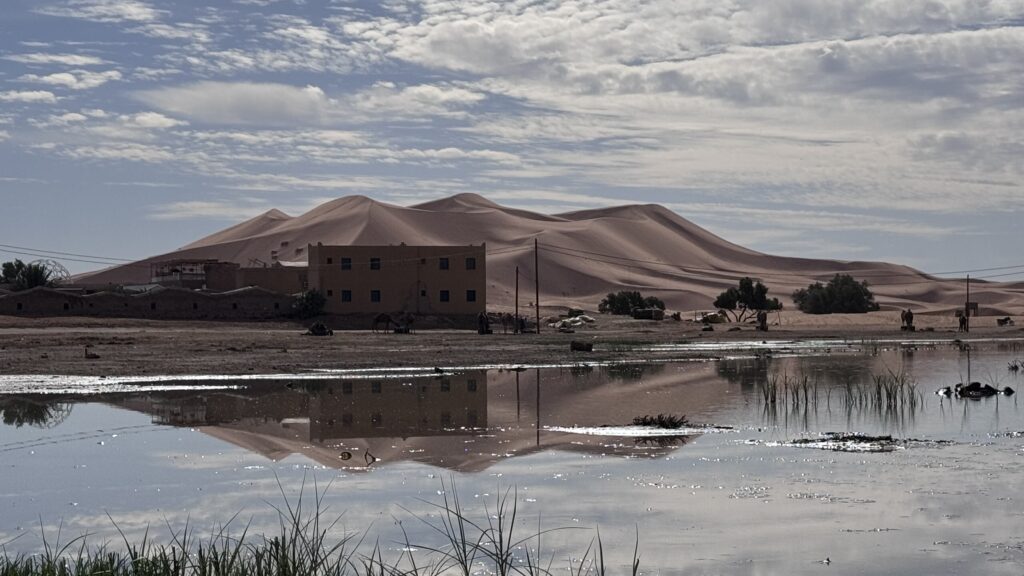
Merzouga is a small, tourism-focused town with guesthouses, hotels, tour offices, cafés and shops along the edge of the dunes. It is a convenient base, but not a quiet village. Expect people to offer tours, quad rides and rooms. Booking ahead and saying a polite ‘no, thank you’ makes arrival easier.
West of town, Dayet Srji is a seasonal lake created by run-off. When it holds water, regional guides say it can attract birdlife, including flamingos. It is not guaranteed in any given month, so treat it as a bonus.
Hassi Labied
Hassi Labied is a small village roughly 4 km north of Merzouga, close to the dunes. Guesthouses and camps line this stretch, and it is a popular alternative if you want a calmer base but still need to be near the sand.
Khamlia village and its Gnawa music
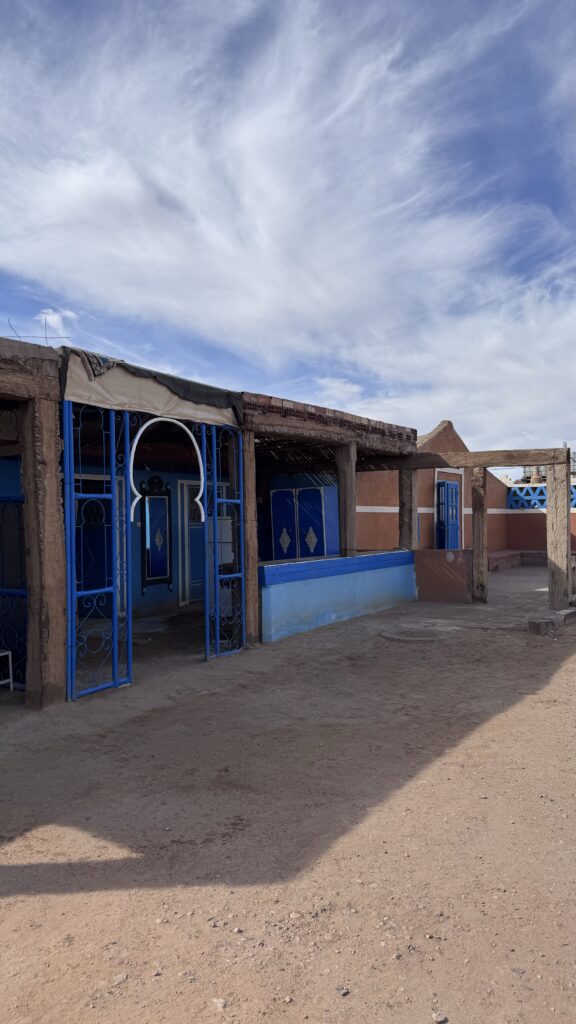
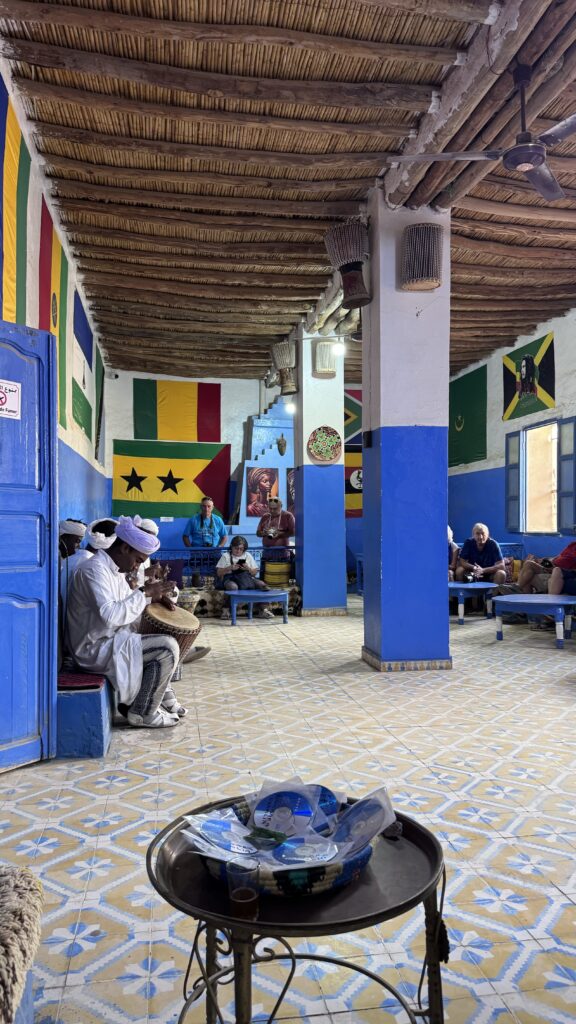
Khamlia lies about 7 km south of Merzouga on the road toward Taouz. It is a small village known for its Gnawa (Gnaoua) community, whose ancestors came to Morocco from sub-Saharan Africa along the trans-Saharan caravan routes.
Their music draws on Bambara traditions, with lyrics that blend Arabic, Berber and Bambara. For many families it is heritage and a living tradition, not just a show.
Some performances and workshops are organised by village groups and a community association, with income supporting local projects. If you want your money to reach the community, ask who is organising the session and how the musicians are paid.
Visiting well
• Agree the arrangement and any fee before the music starts.
• Ask before filming or posting video. Some performers may prefer not to be recorded.
• Dress modestly and treat the performance with respect, especially if it carries spiritual meaning for the musicians.
• A Gnawa festival has been reported in Khamlia in summer. Dates and format can change, so check locally rather than planning around it.
Rissani
Rissani is a historic oasis town about 30 km from Merzouga and the ancient capital of the Tafilalet region. It was a major trans-Saharan trading hub and still has a large market.
The souk is usually described as liveliest on Sundays, Tuesdays and Thursdays. A few sources list different days, so confirm with your guesthouse before you go.
On the southern edge of town stands the mausoleum of Moulay Ali Cherif, linked to the ancestors of the Alaouite dynasty, Morocco’s ruling royal family. Access to the interior may be limited for non-Muslim visitors, so follow local signs and guidance, and dress modestly.
Rissani is also known for stuffed bread, often called medfounaor ‘Berber pizza’. Ask at a local café for the best-known place. A private day trip from Merzouga is typically around six hours including travel and market time.
Sunrise and sunset viewpoints
You do not need a special viewpoint. The best views are usually from a dune crest within walking distance of your camp or guesthouse.
• Sunset: Camel and 4×4 transfers are usually timed so you reach camp as the light turns gold. If you want to climb a dune yourself, ask your camp which dune is closest and easiest to walk.
• Sunrise: Many camps wake guests before dawn to climb a nearby dune. Bring a head torch, a warm layer and water, and aim to reach the crest 20 to 30 minutes before sunrise.
• Other spots: The dune edge at Hassi Labied, the road toward Khamlia with dunes on one side and black desert plain on the other, and Dayet Srji when it holds water.
Dune crests are sharp, and the sheltered side is steep. Follow existing footprints along the ridge, and avoid jumping down slopes you cannot see.
Sunrise and sunset times shift through the year, and Morocco’s clocks are expected to change during Ramadan. Check local times the day before instead of relying on a guidebook.
Desert camps: standard vs luxury
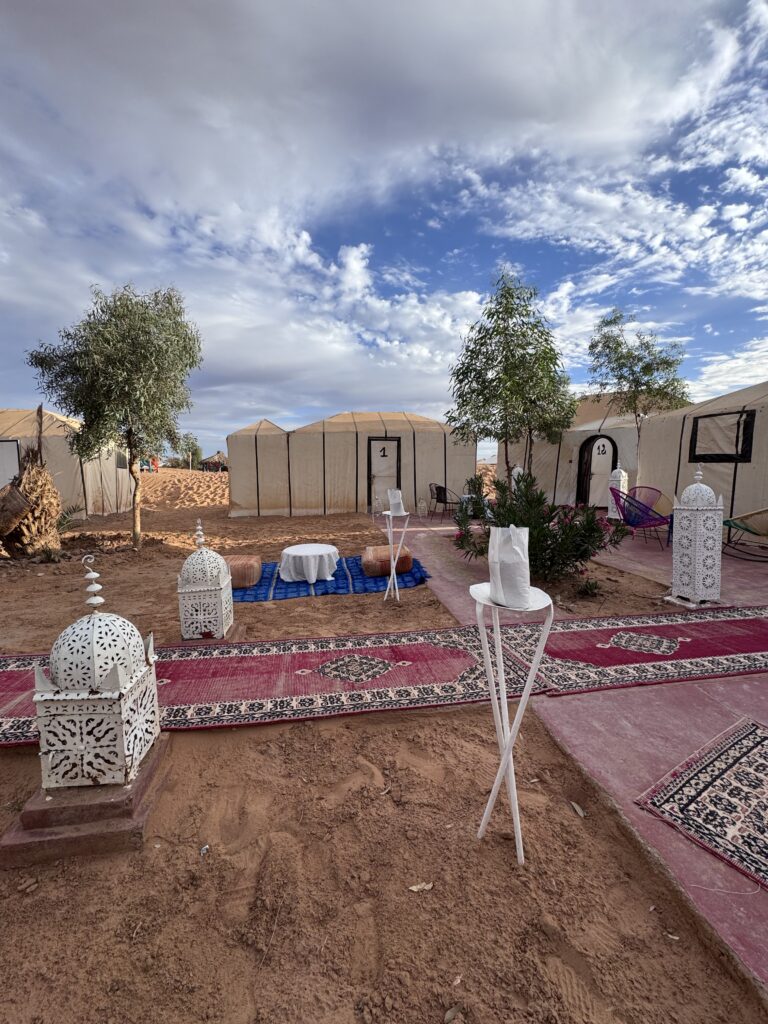
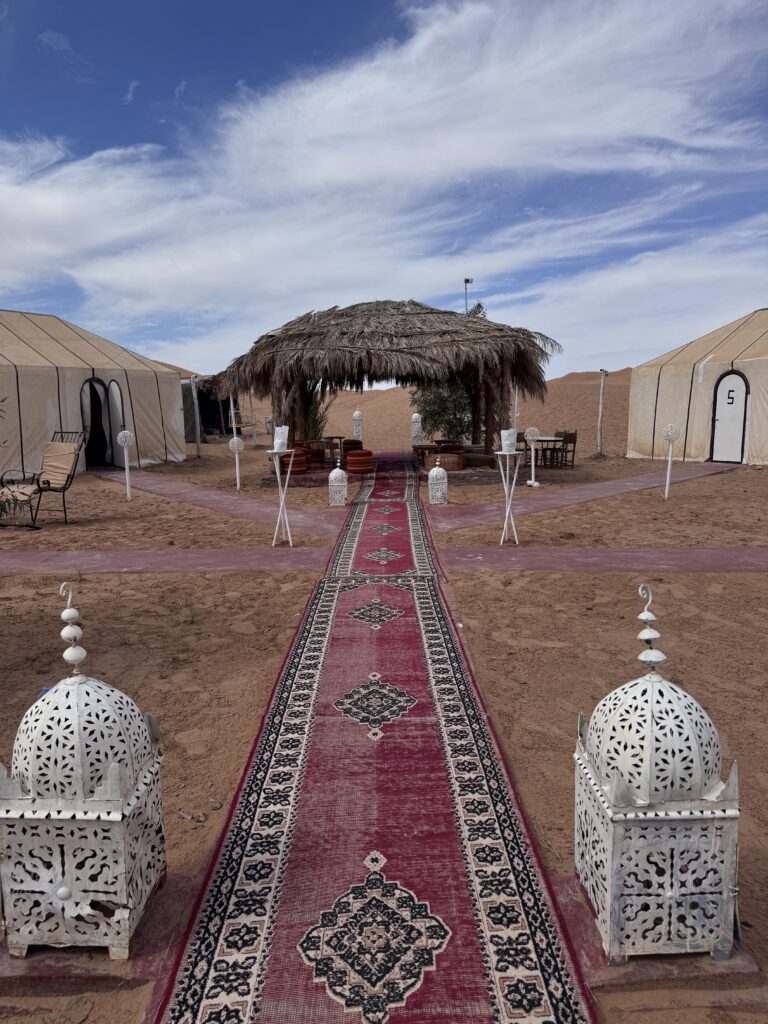
Camps around Erg Chebbi range from simple tents to high-end ‘luxury’ camps. The labels are not regulated, so a camp’s description of the tent and bathroom tells you more than its star rating or name. Use this table as a rough guide.
| Standard camp | Luxury camp | |
| Tent | Private tent with simple beds and blankets. Budget options may share a tent. | Larger private tent, usually with proper beds, rugs and seating |
| Bathroom | Shared toilets and showers in a separate tent or block | Private toilet and shower inside or attached to your tent |
| Hot water and power | Limited. Hot water and charging points may be in common areas. | More likely, but ask about hours |
| Heating and cooling | Extra blankets. Heaters are not guaranteed. | Better bedding. Air-conditioning is rare and usually limited to the top tier. |
| Food | Set dinner and breakfast, often tajine or couscous | Same style of meal, sometimes with more choice |
| Atmosphere | Often communal, with a campfire and drumming | More privacy. Group activities may still be offered. |
How to choose
• Bathroom comfort: If a private toilet matters, choose a luxury camp or get an ensuite tent confirmed in writing.
• Budget: Standard camps cost less, and for many travellers the dunes, sunset and stars are the point.
• Season: In winter, nights are cold, so ask about blankets and heating. In summer, ask how the camp handles heat.
• Atmosphere: If you want drumming and a lively evening, ask whether it is offered. If you want quiet, ask whether music is optional.
• Location: Ask how far the camp is from neighbouring camps and from town.
What bathrooms and showers are like
Water is limited in the desert, so even good camps ration it. At a standard camp, expect shared toilets and showers in a separate tent or block, with water that may be warm, lukewarm or time-limited. At a luxury camp, expect a private toilet and shower attached to your tent, though water pressure and hot-water hours still vary.
Pack wet wipes, a small towel, a head torch, flip-flops and tissues. Some operators let you shower at a base guesthouse in Merzouga before or after the camp night. Ask whether this is included.
How luggage transfers work
Most overnight trips involve taking only a small bag to the camp, usually by camel or 4×4. Your main luggage stays at your hotel, guesthouse or the tour office in Merzouga, or in the vehicle if you are on a multi-day tour.
• Pack a small ‘dune bag’: change of clothes, warm layer, toiletries, head torch, power bank, water bottle, sun protection and camera cover.
• Keep your passport, cash and valuables with you rather than in stored luggage.
• Ask where luggage is stored, whether it is locked, and whether there is a fee.
• If you are self-driving, ask whether parking at the base is free and secure.
What to ask before booking a camp
• Which exact camp will we stay at, and can you send its map location?
• How do we get there: camel, 4×4 or on foot? How long does each leg take?
• Is the tent private, and how many beds does it have?
• Is the bathroom private or shared? Is hot water available, and when?
• What bedding and heating will there be on cold nights?
• What is included (dinner, breakfast, tea, water, sandboards), and what costs extra?
• Is the music optional? Are there noise rules after a certain hour?
• Where is my luggage stored, and where do I park if I am self-driving?
• What happens if the weather turns bad, for example a sandstorm or heavy rain?
• What are the cancellation and refund terms, and how is the deposit paid?
• Can you cater for vegetarian, vegan, gluten-free or allergy needs?
• How are the camels cared for, and can I choose walking or a vehicle instead?
Camel rides and animal welfare
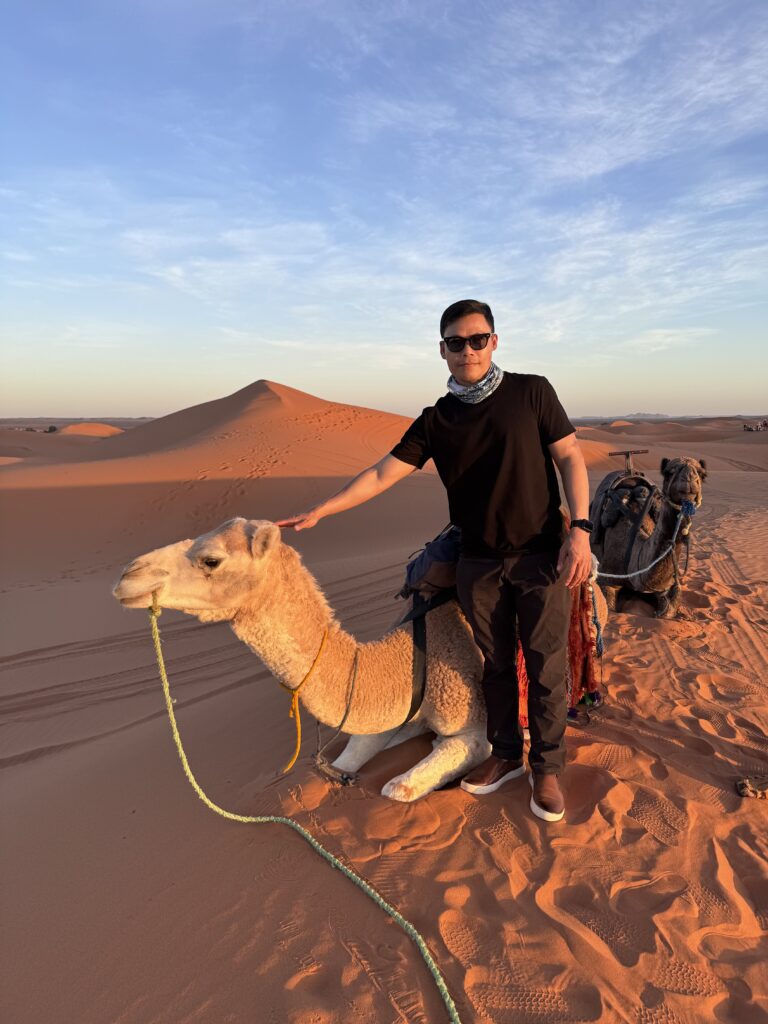
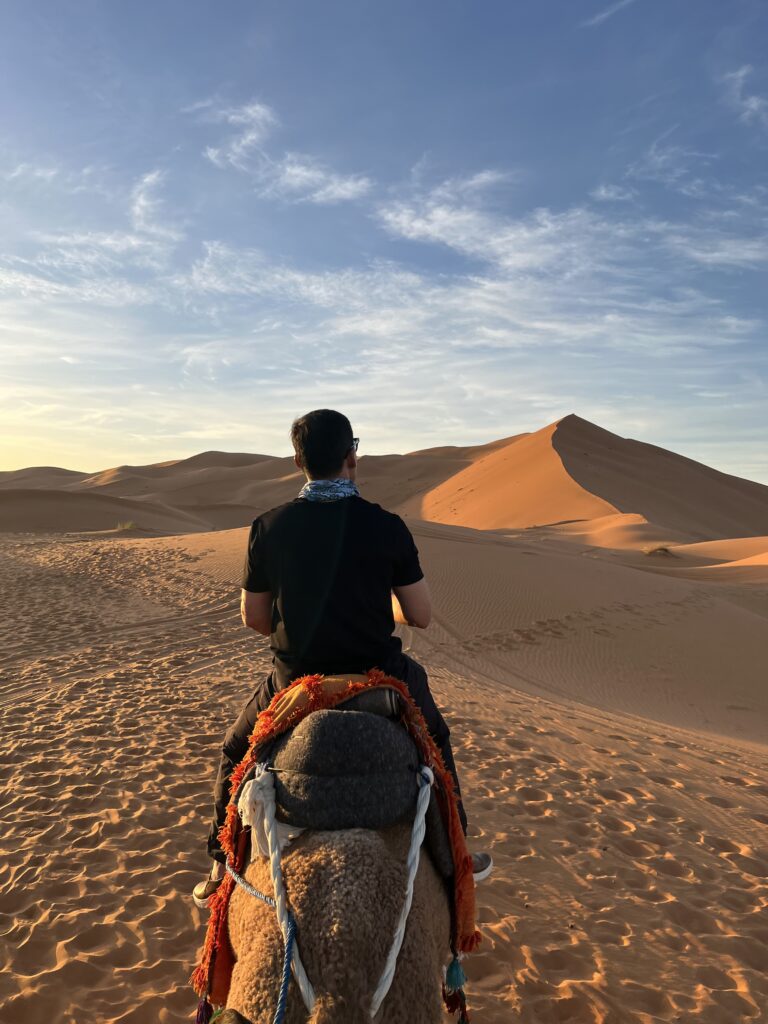
A sunset camel ride is the classic way to reach a desert camp. It is also a real animal-welfare question, and reasonable people disagree. Some animal-protection groups oppose camel riding altogether. Others, including SPANA, advise riding only where animals are well kept and well treated.
This guide does not tell you what to decide. It shows what to look for if you choose to ride, and what to do if you would rather not.
Signs of better practice
• Camels look well fed, alert and calm, not thin, exhausted or limping.
• No visible sores, wounds or swelling, especially around the nose, mouth and back where ropes and saddles sit.
• Handlers lead the animals calmly, with no beating or shouting.
• Rides take place at cooler times, such as late afternoon and early morning, not in the middle of a hot day.
• One rider per camel, with sensible loads.
• The camels can rest, drink and find shade between rides.
Questions to ask the operator
• How many rides does each camel do per day, and do they get rest days?
• Where are the camels kept, and how are they fed and watered?
• How long is the ride, and is the route on gentle terrain?
• Can I walk part of the way or switch to a vehicle?
When to walk away
If a camel looks underweight or exhausted, has visible sores, is being hit, or is tied up in the sun without water, decline the ride. You can tell the operator why, leave an honest review afterwards, or report concerns to an animal-welfare charity such as SPANA.
Alternatives to riding
• Walk to camp. Some camps are within walking distance. Ask for the distance and terrain, and take water and sun protection.
• Vehicle transfer. A 4×4 can take you and your luggage to many camps. Ask the driver to stay on established tracks to limit damage to the desert.
• Walk beside the luggage. Some operators use a camel to carry bags while guests walk. This still involves an animal, so apply the same welfare checks.
• Skip the ride. Spend sunset on a dune crest near your guesthouse instead.
In summer, some operators move rides to dawn and dusk to avoid midday heat, which is kinder to animals and riders alike. Quad bikes and buggies have their own downsides: noise, fumes and disturbance to the dunes and wildlife.
Stargazing, sandboarding and guided excursions
Stargazing
Clear air and little light pollution make Erg Chebbi a strong place for stargazing, though neighbouring camps can add some light compared with more remote dunes such as Erg Chigaga.
• Check the moon phase before you go. A new moon gives the darkest skies.
• Let your eyes adjust for about 20 minutes and avoid white light. A red head torch helps.
• Bring a warm layer, even in spring or autumn.
• For photos, bring a tripod and shoot away from camp lights.
• Clouds, dust and haze can spoil any night, so build in a second night if stars are a priority.
Sandboarding
Many camps provide sandboards, often at no extra cost. Climbing is the hard part: every run means a climb up soft sand, so pace yourself.
• Go in the early morning or late afternoon. Midday sand can be very hot.
• Wear sunglasses or goggles and a scarf, and keep your mouth closed on fast runs.
• Start on a gentle slope, and check nobody is below you.
• Check the board is in good condition before you use it.
Guided desert excursions
• 4×4 dune drives: Tours through the dunes and out to the plains, sometimes with a visit to a nomad family or village. Ask what the stops are and how long they last.
• Khamlia and Gnawa music: Often combined with a short desert drive.
• Rissani day trip: Market, mausoleum exterior and local food.
• Quad bikes and buggies: Popular, but noisy. Ask about the safety briefing and whether helmets are provided.
• Nomad family visits: Choose experiences that feel like a visit, not a photo stop. Ask what the host receives and whether visitors are expected to buy something.
Hire guides who carry an official guide badge, and agree the price, route and duration before you set off.
Best time to visit Erg Chebbi
Spring and autumn are the most comfortable seasons, and local operators have described October and November as a ‘golden season’ for desert tourism. Winter has pleasant days but cold nights. Summer is very hot.
| Season | Daytime | Nights | What to know |
| Spring (Mar–May) | Mid-20s to low-30s °C. April averages about 29 °C; May is hotter. | Cool to mild. April lows average around 15 °C. | Often considered the best window. Wind and sand haze are possible. Book early for holidays. |
| Summer (Jun–Aug) | About 38–42 °C | Warm, but cooler than the day | Midday is too hot for dune walks. Plan activities for dawn and dusk and drink plenty of water. |
| Autumn (Sep–Nov) | About 36 °C in September, easing to about 30 °C in October and cooler in November | Cooling steadily | Popular season. Storms are possible, and heavy rain can damage tracks. |
| Winter (Dec–Feb) | Around 18 °C | Can approach freezing on clear nights | Sunny, quiet days but short daylight. Bring warm layers and ask about blankets and heating. |
Figures are approximate monthly averages from public climate summaries. Desert conditions swing widely between day and night, and individual days can be much hotter, colder or windier.
Rain and roads: Rain is rare but can be heavy, and flash floods can wash out tracks. Local operators reported that heavy rain damaged some desert tracks in the previous season. In winter, snow can briefly close the Tizi n’Tichka pass on the Marrakech route, so allow flexibility.
Ramadan 2027: Expected to begin around 7–8 February 2027 and end around 8–10 March 2027, depending on moon sighting. Camps and tours generally still operate, but daytime eateries in smaller towns may be closed or quiet. Morocco’s clocks are expected to go back an hour for the month, so sunrise and sunset will appear an hour earlier on the clock.
What to pack
Clothing
• Lightweight, breathable long sleeves and trousers for sun and sand.
• A scarf or turban-style cloth for sun, wind and dust. Some tours do not supply one.
• Sunglasses and a wide-brimmed hat or cap.
• Closed shoes you can empty sand from, plus sandals for camp.
• Warm layers for evenings and the dawn climb. Add a hat and gloves in winter.
• Modest clothes for towns and villages, with shoulders and knees covered.
Gear
• Head torch (red-light mode if possible) and spare batteries.
• Power bank and a short charging cable.
• Small overnight bag or soft daypack.
• Reusable water bottle.
• High-SPF sunscreen, lip balm and moisturiser.
• Wet wipes, tissues and hand sanitiser.
• Earplugs, if you want to sleep through evening drumming.
• Basic medication, rehydration salts and blister plasters.
• Passport, insurance details and offline copies of your bookings.
Sand protection for cameras and phones
• Keep gear sealed in zip-lock or dry bags whenever you are not shooting, especially when it is windy.
• Change lenses indoors, in a vehicle or inside your tent, never on open sand.
• Consider one zoom lens for the whole trip to reduce lens swaps.
• Fit a clear or UV filter to protect the front element.
• Blow off loose grit with a hand blower first, then use a soft brush and microfibre cloth. Never rub sand across glass.
• Avoid compressed-air cans, which can push grit deeper.
• Keep charging ports and card slots covered, and use a phone pouch or case.
• Carry spare batteries and keep them warm at night, because cold drains them quickly.
• Pack silica gel packets to reduce condensation between cold nights and warm days.
• Never put a camera down on the sand. Use a strap or bag.
Hydration and heat
Drink water regularly instead of waiting for thirst, and carry a bottle on every dune walk. Many travellers aim for two to three litres a day in warm months. That is a rough guide, not medical advice. Sealed bottled water is widely available, and some camps may offer large refill jugs, which cuts plastic waste. Ask in advance.
Watch for headache, dizziness, nausea or unusual tiredness. Rest in shade, drink fluids and get help if symptoms do not improve.
Cash and cards
• The currency is the Moroccan dirham (MAD). Bring small notes and coins for tea, tips and toilets.
• Merzouga and nearby towns such as Rissani, Erfoud and Errachidia have ATMs, but machines can be empty or out of order. Withdraw when you pass a working one, not at the last minute.
• Many hotels and larger camps accept cards, but cafés, small shops and camp extras are often cash-only. Ask in advance how, and in which currency, you pay the balance.
• Tipping is customary. Ask your host what is usual for drivers, guides, camp staff and musicians.
Mobile coverage and Wi-Fi
Merzouga town and the main roads usually have a signal, but coverage often drops or disappears at camps. Some luxury camps offer Wi-Fi, which can be slow and limited to common areas. Maroc Telecom is widely reported to have the widest rural coverage of Morocco’s three networks (Maroc Telecom, Orange and Inwi), so if you buy an eSIM for the desert, check which network it uses.
• Download offline maps before you leave town.
• Share your camp name and itinerary with someone at home.
• Treat any signal at camp as a bonus.
Local customs and respectful travel
• Greetings: A handshake and ‘salam alaykum’ are a good start. Use your right hand for eating, giving and receiving.
• Dress: Cover shoulders and knees in towns and villages. In the dunes, lightweight long layers suit the sun and sand anyway.
• Tea: Mint tea is a sign of hospitality. Accepting a glass is polite, and you can decline further glasses graciously.
• Shoes: Remove your shoes when entering a Berber tent or a home if others do.
• Public behaviour: Keep affection discreet and voices calm in markets and villages.
• Ramadan: Eat, drink and smoke discreetly in public during daylight hours, out of respect for those fasting.
• Haggling: Bargaining in souks is normal. Stay friendly, and only ask for a price if you are willing to buy.
• Alcohol: Simple camps often do not serve it, and some luxury camps may. Ask in advance rather than assuming.
• Rubbish: Take your litter with you or use bins at camp. The desert is not a dump.
• Drones: Drones are heavily restricted in Morocco. Check current rules and authorisation before bringing one.
• Border area: The Algerian border is nearby. Stay with your guide on desert trips, and do not wander toward border areas.
Halal food and dietary needs
Morocco is a Muslim-majority country, and the meat served in restaurants and camps is halal as a matter of course. Pork is not normally served.
Camp dinners are usually a set meal: soup or salad, a tajine or couscous, bread, fruit and mint tea. Breakfast often includes bread, jam, olives, eggs and tea or coffee.
• Vegetarians and vegans: Vegetable tajines and couscous are common, but meat is the default. Request your meal when booking and confirm again on arrival.
• Gluten-free and allergies: Tell the camp in advance. Do not rely on a verbal assurance on the day.
• Muslim travellers: Ask where and in which direction to pray at camp. During Ramadan, ask whether iftar is offered and at what time.
• Water: Choose sealed bottles and check the seal.
Respectful photography
• Ask before photographing people, especially women, older people and children. A smile and a gesture is often enough, and showing the photo afterwards is appreciated.
• If someone says no, accept it.
• Some people may ask for a tip. Decide beforehand whether you are comfortable with that.
• Do not photograph people during prayer, and ask before taking photos in or around mosques and shrines.
• Ask musicians before filming them, and credit them if you post their performance.
• Avoid photographing police, military or border installations.
• In camp, avoid shining torches or flash into other guests’ tents or at animals.
How to get to Merzouga from Marrakech or Fes
Merzouga is a long way from both cities. Plan the drive as part of the trip, not as a transfer.
| Route | Distance | Driving time without stops | Realistic travel day |
| Marrakech to Merzouga | About 550–560 km | Roughly 8–9 hours by some estimates; 9–12 hours is more realistic | 10–13 hours with meals, photo stops and fuel. Many travellers split it over two days. |
| Fes to Merzouga | About 450–460 km | Roughly 7–9 hours | 8–10 hours with stops. Often split with a night in Ifrane, Azrou or Midelt. |
| Errachidia airport to Merzouga | About 125–130 km | Around 2 hours | Fly in, then take a pre-booked transfer or taxi. |
From Marrakech
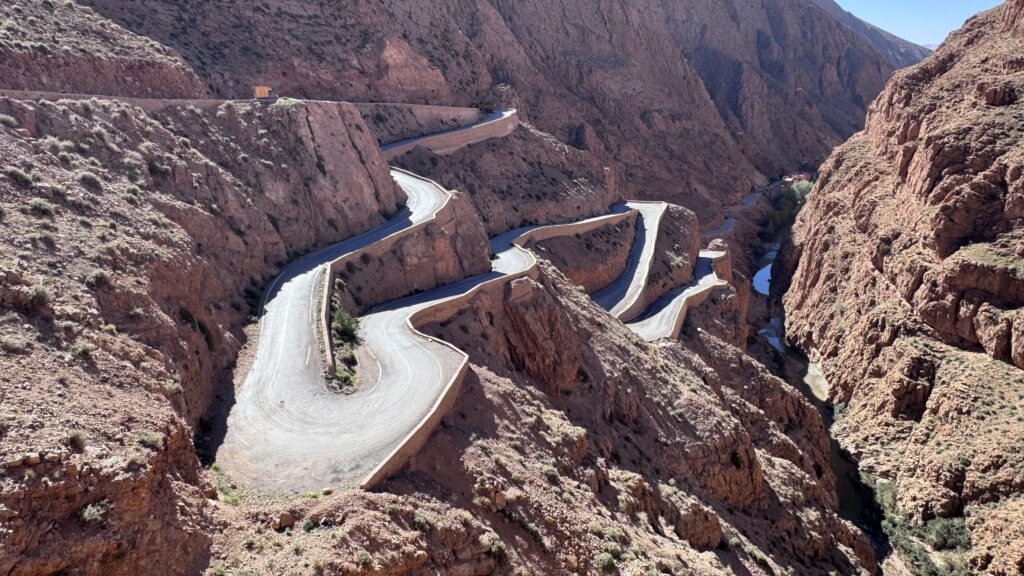
The usual route crosses the High Atlas over the Tizi n’Tichka pass (about 2,260 m, roughly two hours from Marrakech). It then passes Aït Benhaddou, Ouarzazate, the Dadès Valley and Todra Gorge before turning south-east to Merzouga. The road is scenic but winding, so bring travel-sickness remedies if you need them. In winter, snow can briefly close the pass.
From Fes
The Fes route runs through Ifrane (about 1.5 hours from Fes), the cedar forests near Azrou, Midelt and the Ziz Valley, then Errachidia and Erfoud before reaching Merzouga. It is shorter than the Marrakech route, with more mountain scenery and fewer headline attractions. If you meet wild Barbary macaques on the way, avoid feeding them.
Bus, flights and self-drive
• Bus: Supratours and CTM run long-distance routes. A Supratours bus from Fes to Merzouga is reported to take around 10–11 hours. Sources disagree on whether there is a direct Marrakech–Merzouga bus: some list a single long service and others route via Meknes. Check supratours.ma and ctm.ma for current timetables.
• Flights: Royal Air Maroc flies between Casablanca and Errachidia (ERH). Seasonal routes from Europe have been reported for winter 2026–27, for example from Paris Orly from late October, but check the airline for current schedules. From Errachidia, allow about two hours by road to Merzouga.
• Self-drive: Fill up in larger towns such as Midelt or Errachidia. Avoid driving after dark because of livestock and unlit vehicles, and allow extra time for checkpoints and mountain driving. Many visitors prefer to hire a driver on this route.
• One-way trips: Linking Marrakech and Fes via Merzouga avoids backtracking. Ask about one-way surcharges and drop-off fees.
Why short tours mean very long driving days
A 2-day or 3-day ‘desert tour’ can look efficient on paper. In practice, most of your time is spent in the vehicle.
| Tour | Typical shape | Driving load |
| 2 days / 1 night from Fes | Day 1: leave early, drive via Ifrane and Midelt, arrive for a late-afternoon camel ride and camp. Day 2: return to Fes. | Roughly 7–9 hours each way, so about 15–18 hours of driving for one night in the desert |
| 3 days / 2 nights from Marrakech | Day 1: Marrakech to the Dadès or Todra area. Day 2: continue to Merzouga for the camel ride and camp. Day 3: return to Marrakech. | Around 18 hours or more over three days, including a very long final day |
These are estimates, and exact schedules vary by operator. If you can, add a night. Four days gives you time for a proper sunrise, a visit to Khamlia or Rissani, and a more relaxed return. Two nights near Merzouga beats one.
When comparing tours, check that the itinerary lists drive times and leaves enough time in Merzouga. Ask who is driving, how many hours they drive each day, and where the rest stops are.
Sample itineraries
2-night Merzouga itinerary
This plan assumes you reach Merzouga around midday on Day 1 and stay in the area for two nights.
Day 1: Arrive and sleep in the dunes
• Arrive and check in at your guesthouse or base. Leave your main luggage, pack a dune bag and rest through the hottest hours.
• Mid-afternoon: travel to camp by 4×4, on foot or by camel.
• Watch sunset from a dune crest, then enjoy mint tea and dinner.
• After dinner: music if you want it, then stargazing away from the campfire.
Day 2: Sunrise, Khamlia and an easy afternoon
• Pre-dawn: climb a nearby dune for sunrise.
• Breakfast at camp, then return to Merzouga to shower and rest.
• Late morning: visit Khamlia for Gnawa music and tea.
• Afternoon: free time. On a Sunday, Tuesday or Thursday, consider the Rissani souk instead (check market days first).
• Late afternoon: sandboarding or a 4×4 dune drive, and sunset.
• Night 2: sleep in a guesthouse in Merzouga or Hassi Labied for hot water and a proper bed, or return to camp for a second chance at the stars.
Day 3: Easy morning and departure
• Optional short sunrise walk, then breakfast and luggage.
• Start the journey out. Allow a full travel day if you are heading to Marrakech or Fes.
Sample multi-day route: Marrakech to Fes via Merzouga (5 days)
| Day | Route | Approx. driving | Overnight |
| 1 | Marrakech, Tizi n’Tichka pass, Aït Benhaddou, Ouarzazate | 4–5 hours | Ouarzazate or Skoura |
| 2 | Ouarzazate, Dadès Valley, Todra Gorge | 3–4 hours | Dadès or Tinghir |
| 3 | Todra, Erfoud or Rissani, Merzouga. Late-afternoon transfer to camp, sunset and stars. | 3–4 hours | Desert camp |
| 4 | Sunrise and breakfast, Khamlia or Rissani, then Merzouga, Errachidia and Midelt | 4–5 hours | Midelt |
| 5 | Midelt, Azrou, Ifrane, Fes | 3.5–4 hours | Fes |
Driving times are rough estimates without stops. Reverse the order to travel from Fes to Marrakech. For a slower pace, add a second night in Merzouga between Days 3 and 4.
Tour prices: what is usually included and excluded
Prices vary by season, group size, vehicle, camp level and distance, so this guide does not quote figures. Use these checklists to compare quotes like for like.
Usually included (varies by operator)
• Transport with a driver for the whole route (minivan or 4×4).
• Hotel, riad or guesthouse nights, usually with breakfast.
• A desert camp night with dinner and breakfast.
• A camel ride or vehicle transfer to camp.
• Mint tea, sandboards, and parking at the base in some packages.
Often excluded
• Lunches and drinks along the way.
• Entrance fees and local guide fees at sites.
• Tips for drivers, guides and camp staff.
• Optional extras such as quad bikes, buggies or private 4×4 drives.
• Camp upgrades such as a private bathroom.
• Single-room supplements.
• Flights, travel insurance and personal expenses.
• Surcharges for short tours or one-way routes, which some suppliers apply.
How to compare and vet operators
• Is the price per person or per vehicle? Is the tour private or shared, and what is the maximum group size?
• Ask for a written itinerary that names the hotels, the camp and the drive times.
• Ask for licence or registration details, and verify them yourself with the Moroccan tourism authorities.
• Read recent, detailed reviews on several independent platforms. Be wary of a company that shows testimonials only on its own site.
• Get cancellation, weather and refund terms in writing.
• Be cautious about paying everything upfront. Use a secure payment method and keep receipts.
• Ask about compulsory shopping stops.
• Compare vehicles: air-conditioning, seat belts and luggage space.
This guide does not recommend specific operators, because quality changes and any recommendation should rest on checks you make yourself.
Frequently asked questions
What is the difference between Erg Chebbi and Erg Chigaga?
Erg Chebbi is near Merzouga, is easier to reach and has many camps. Erg Chigaga is near M’Hamid, needs a 4×4 to reach, has fewer camps and feels more remote.
How many nights should I spend near Merzouga?
Two nights is a good balance: one in a camp and one in a guesthouse, or two in camp. One night works if you are short on time, but expect very long driving days.
Can I visit Erg Chebbi as a day trip from Marrakech or Fes?
Not realistically. The drive is too long. Plan at least one night in Merzouga, and ideally more.
Do I have to ride a camel?
No. You can usually walk or take a 4×4 to camp. Ask the operator when you book.
Is a luxury camp worth it?
If you want a private bathroom, better bedding and hot water, yes. If your priority is the dunes and stars, a standard camp may be enough. Check the specific details rather than the label.
What is the best month to go?
March to May and October to November are the most comfortable. Winter nights are cold, and summer days are very hot.
How cold do the nights get?
In winter, nights can approach freezing even though days feel mild. Bring warm layers.
Will my phone work?
Signal in Merzouga town is usually available, but it is often weak or absent at camps. Wi-Fi, where offered, can be slow.
Is it safe?
Merzouga is a well-established tourist area. As anywhere, follow your guide’s advice, take heat and weather seriously, stay out of border areas, share your itinerary, and check your government’s current travel advice.
Can I travel solo?
Yes, many people do. Choose accommodation and operators carefully, read recent reviews, dress modestly and trust your instincts.
Is the food halal, and are vegetarian meals available?
The meat is halal, and pork is not normally served. Vegetarian meals are usually possible if you ask in advance.
How much cash should I carry?
Enough for tips, meals not included and small extras. ATMs exist but can be unreliable, so ask your host what must be paid in cash.
Is Erg Chebbi suitable for children?
Many families visit. Consider the long drive, heat, sun protection and any camel-ride age limits, and ask the camp about its policies.
Which days is the Rissani souk open?
It is usually described as liveliest on Sundays, Tuesdays and Thursdays. Confirm locally.
Do I need a 4×4 to reach Merzouga?
No. Paved roads reach Merzouga. A 4×4 is mainly used for off-road transfers to some camps and for desert tracks.