
A first-timer’s guide to flying into Seattle, driving to the mountain, and hiking one of the most spectacular trails in the Pacific Northwest.
There’s a moment, somewhere on the drive south from Seattle, when the horizon simply disappears and a mountain takes its place. Mount Rainier doesn’t announce itself gradually the way other peaks do. One minute it’s a rumor in the distance; the next, it fills the entire windshield — 14,411 feet of glacier and rock, standing alone above the Cascade foothills like it has something to prove.
This is the story of a single day spent chasing that mountain: a flight into Seattle, a drive through evergreen corridors, and a hike along the Skyline Trail that left me rethinking what “beautiful” actually means.
Getting There: Seattle to Rainier
Flying into Seattle-Tacoma International Airport (SEA) is the easiest starting point for a Rainier trip — most major US and international carriers fly here directly, and the airport itself is only about a two-hour drive from the mountain, depending on which entrance you’re headed to.
I picked up a rental car directly from the airport (nearly every major rental company has a counter at SEA), and within twenty minutes I was already trading airport traffic for tree-lined highway. If you’re renting a car for a mountain trip like this, a compact SUV or crossover is the sweet spot — you don’t need four-wheel drive in summer, but the extra ground clearance is reassuring on some of the park’s older access roads.
The drive itself is part of the experience. Highway 706 into the park’s Nisqually entrance winds through small logging towns and increasingly dense forest, and about forty minutes in, the trees briefly part and you get your first real look at the mountain — pull over if you can. It’s worth the thirty seconds.
Arriving at the Park
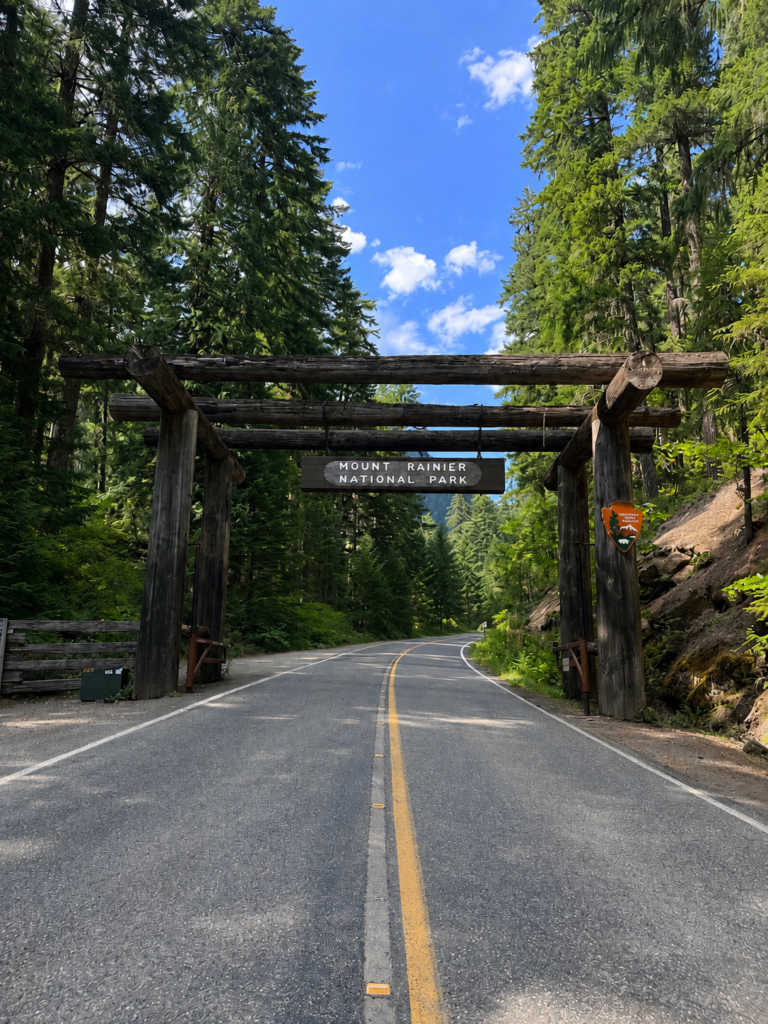
Mount Rainier National Park operates on a timed-entry reservation system during peak summer months (typically late May through early September), so this is genuinely the first tip I’d give any first-time visitor: book your entry reservation in advance, ideally weeks ahead. Showing up without one during peak season means you may not get in at all.
Once inside, the road climbs steadily through old-growth forest before opening into Paradise, the park’s most popular hub — and the trailhead for the Skyline Trail.
Parking at Paradise fills up fast, often by mid-morning on clear summer days. I arrived just after 8am and still found the lot nearly full. If you can manage an early start — even 7am — you’ll save yourself the frustration of circling for a spot while the mountain sits there taunting you from above the treeline.
The Henry M. Jackson Visitor Center
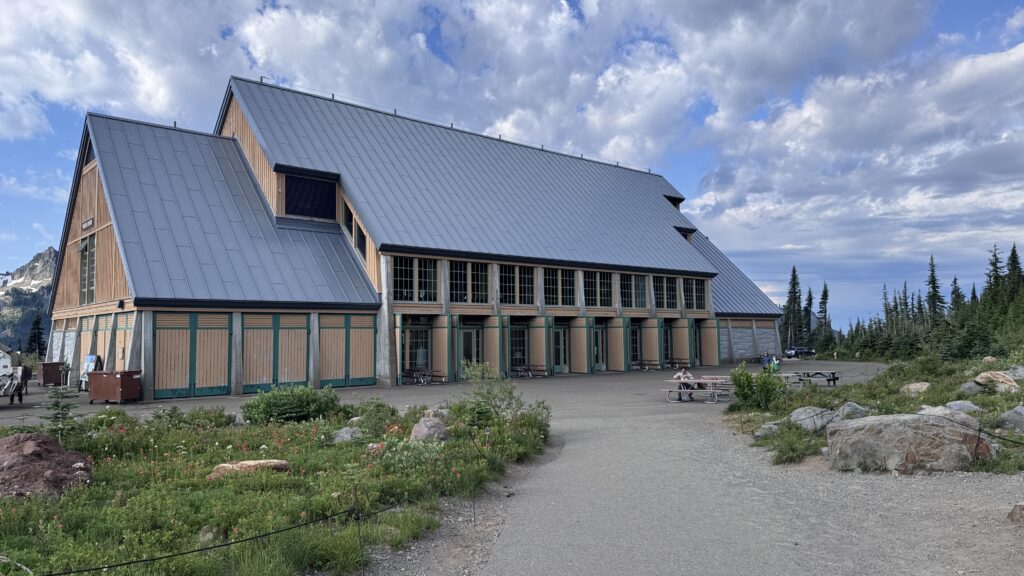
Before starting the hike, I stopped inside the Henry M. Jackson Visitor Center, which sits right at the Paradise trailhead. It’s a genuinely useful first stop — the rangers post daily trail conditions (snow lingers on parts of the Skyline Trail well into July some years), and there are clean restrooms, water refill stations, and a small exhibit on the mountain’s volcanic history and glaciers.
Hiking the Skyline Trail
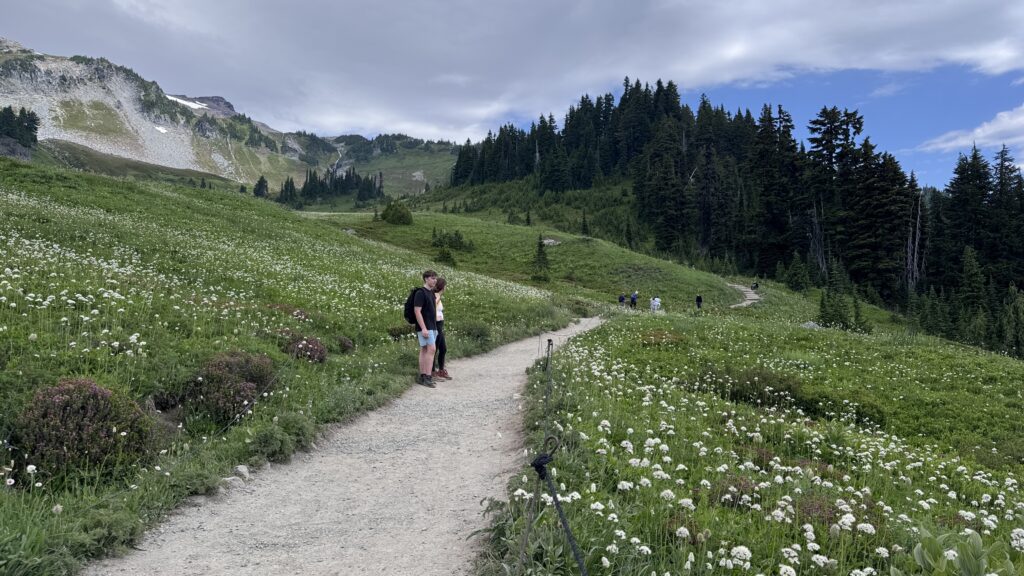
The Skyline Trail is a roughly 5.5-mile loop with about 1,700 feet of elevation gain — moderate to strenuous, but almost every section rewards you generously for the effort. This is widely considered one of the best day hikes in the entire National Park System, and after walking it myself, I understand exactly why.
The Wildflower Meadows
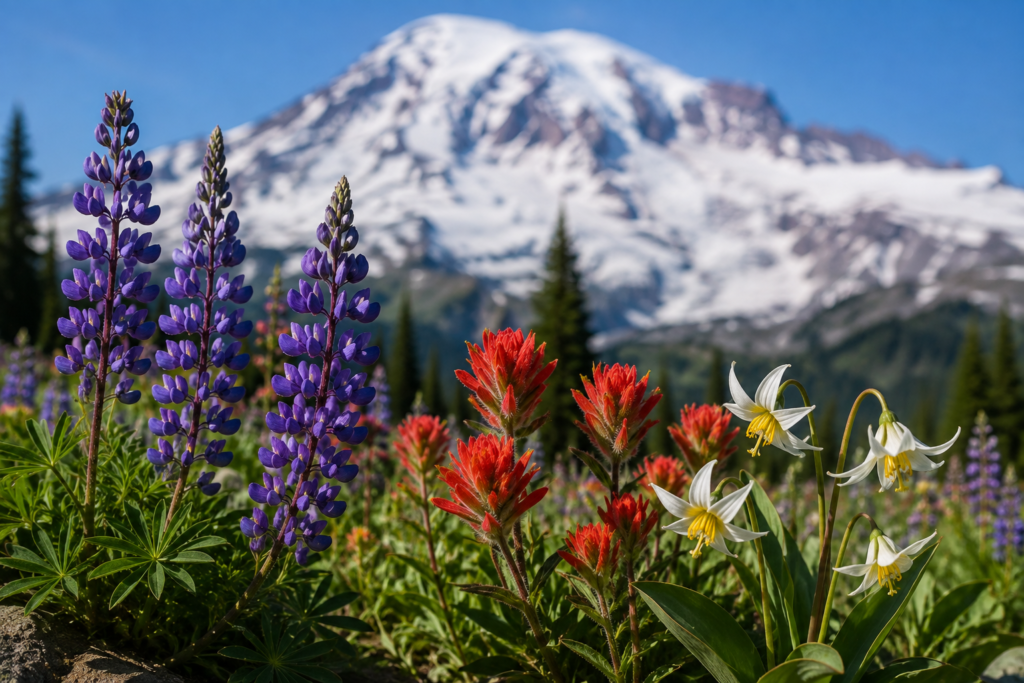
Within the first mile, the trail opens into subalpine meadows that, in peak bloom (typically late July through mid-August), explode into color — purple lupine, white avalanche lilies, deep red paintbrush, all scattered across green slopes with Rainier looming directly above. Photographers plan entire trips around this two-to-three-week bloom window, and standing in the middle of it, I understood the obsession.
Wildlife Along the Way
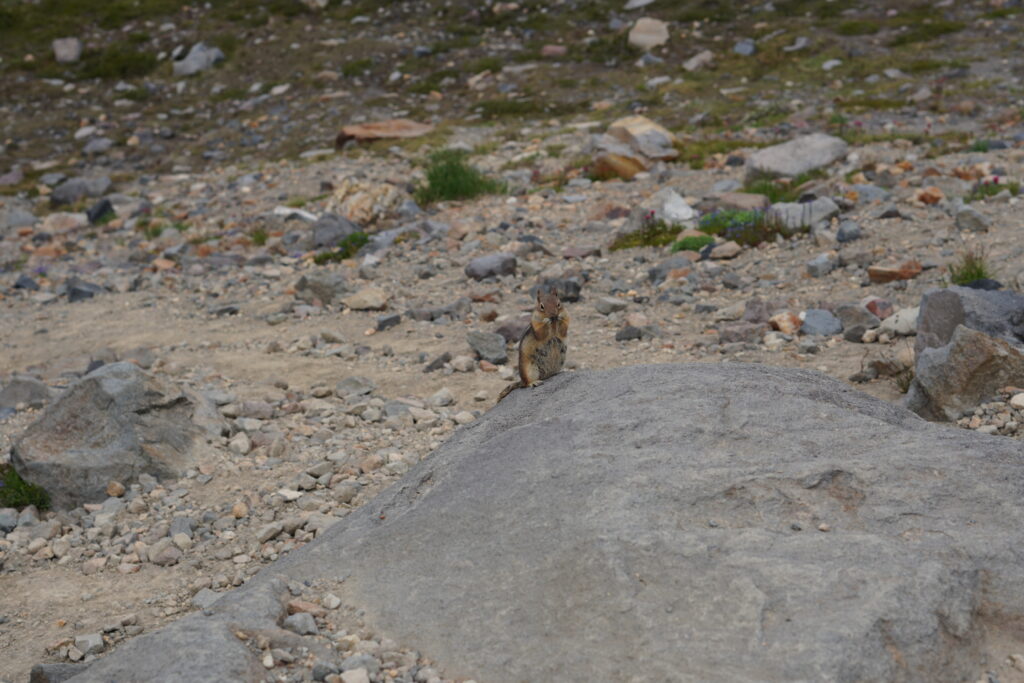
The meadows aren’t just flowers — they’re alive with movement. Golden-mantled ground squirrels dart between rocks at nearly every switchback, unbothered by hikers and clearly used to the foot traffic. Higher up, if you’re patient and quiet, you’ll likely spot hoary marmots — Rainier’s signature alpine mammal — sunning themselves on boulders or letting out their sharp, whistling alarm calls across the meadow. I sat for nearly ten minutes watching one groom itself on a rock just off the trail, completely unbothered by my presence.
Tip: keep a respectful distance from wildlife and never feed them — human food genuinely harms these animals, and rangers actively enforce this.
Mountain Streams and Snowmelt
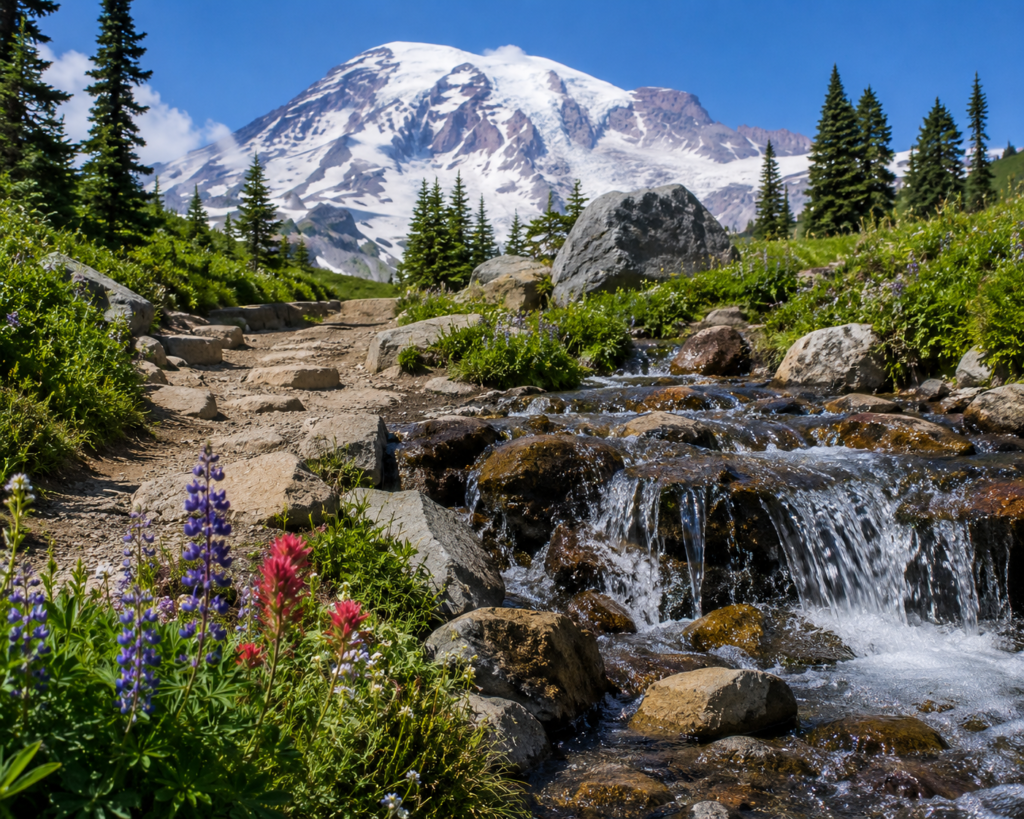
As the trail climbs, you’ll cross several small streams fed directly by glacial snowmelt — startlingly clear, cold water cutting through rock and meadow. These crossings are some of the most photogenic spots on the entire loop; the contrast between the white rushing water, green meadow grass, and the glacier above is the kind of shot that doesn’t need much editing to look extraordinary.
The Mountain Itself
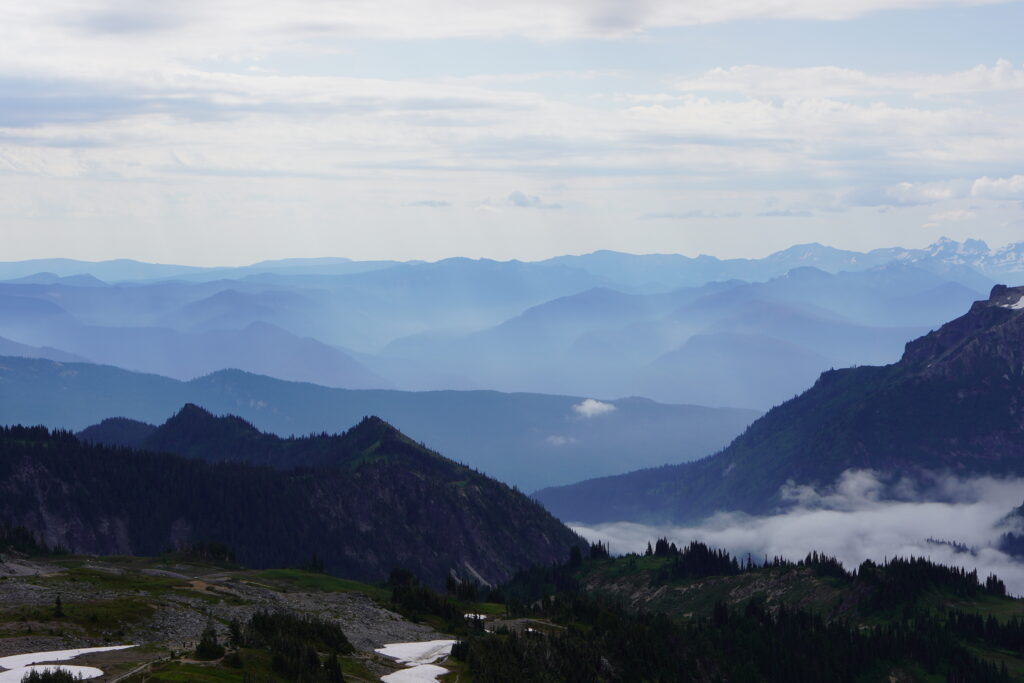
Around the trail’s high point near Panorama Point, the tree cover disappears entirely and Rainier fills the sky — close enough that you can make out individual crevasses in the glaciers, and on clear days, distant peaks like Mount Adams and even Mount St. Helens are visible to the south. This is the moment the entire hike builds toward, and no photograph fully captures standing there in person, wind pulling at your jacket, glacier ice groaning somewhere above you.
Driving Deeper Into the Park
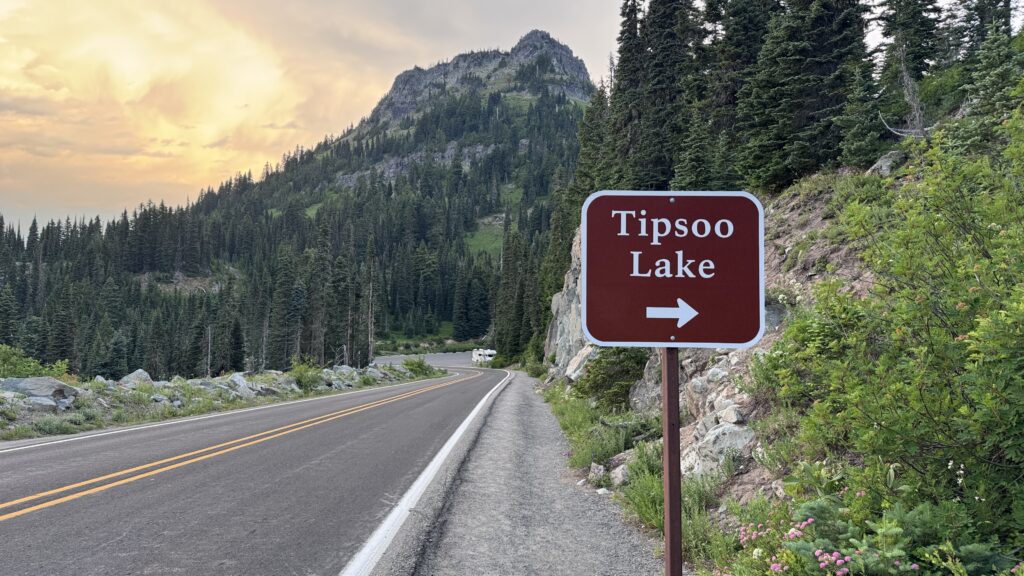
[IMAGE: Scenic road shot inside the park — forest-lined road with mountain glimpses, or a pullout viewpoint]
After the hike, I spent the afternoon driving further into the park rather than heading straight back out. Stevens Canyon Road and the drive toward Reflection Lakes offer some of the most rewarding scenery you’ll see without leaving your car — and on a still morning or evening, Reflection Lakes genuinely lives up to its name, mirroring the mountain perfectly across the water when the wind cooperates.
Tip: sunrise and sunset are the best times for Reflection Lakes — midday sun flattens the reflection and the light gets harsh.
Where to Stay: A Bed & Breakfast Near the Park
Rather than staying inside the park itself (Rainier’s in-park lodges book out months in advance), I opted for a bed and breakfast just outside the park boundary, near the small town of Ashford. This turned out to be one of the best decisions of the trip — a quiet, home-cooked breakfast before an early trailhead start beats a rushed hotel continental breakfast every time, and the owners were full of local trail advice that didn’t make it into any guidebook.
Tip: book lodging near the park months ahead if you’re visiting during peak summer — options are limited and fill quickly, especially anything within a 20-minute drive of an entrance.
Final Thoughts
Mount Rainier isn’t a mountain you casually glimpse from a distance and check off a list. It’s a place that asks something of you — an early alarm, a few miles of climbing, a little patience with marmots and parking lots — and gives back generously in return. Between the wildflowers, the wildlife, the glacier views, and the quiet mornings just outside the park, this was, without question, one of the most beautiful single days I’ve spent outdoors.
If you’re planning your own trip, my honest advice is simple: go early, book ahead, and give yourself more time than you think you need. The mountain rewards those who slow down for it.
Quick Trip Tips Recap
- Book your park entry reservation in advance during peak season (late May–early September)
- Arrive at Paradise by 7–8am to secure parking
- Peak wildflower bloom is typically late July through mid-August
- Keep distance from wildlife — don’t feed marmots or squirrels
- Photograph Reflection Lakes at sunrise or sunset, not midday
- Book RB&B or lodging months ahead if visiting in summer
Have you hiked the Skyline Trail, or are you planning your own trip to Mount Rainier? Let me know in the comments — I’d love to hear what you’re most looking forward to.